
PICO – Platform for Imaging Cavalieri Ottolenghi
The rapid evolution of microscopy technologies, together with the increasing complexity of sample preparation and data analysis, makes it essential to centralize expertise and instrumentation within a single, accessible resource. The Imaging and Microscopy Platform was established to meet these needs, providing the scientific community with a highly specialized center offering advanced imaging capabilities for morphological, functional, quantitative, and three-dimensional applications.
The facility hosts state-of-the-art systems spanning scanning and transmission electron microscopy, high-resolution confocal imaging, multiphoton microscopy, light sheet and widefield imaging, as well as digital slide scanning and advanced morphometric reconstruction. The integration of these complementary modalities enables researchers to address a broad range of experimental requirements, from subcellular ultrastructure to whole-organ 3D imaging.
In addition, the platform offers dedicated workstations for data processing, 3D reconstruction, statistical analysis, and quantitative morphometry, supported by specialized software for neuroscience, cellular biology, and anatomical studies. Real-time live-cell imaging systems, quantitative microscopy tools, and high-throughput acquisition platforms further enhance the facility’s capabilities, creating a comprehensive environment for multidisciplinary research and advanced technical training.
Equipment
Scanning Electron Microscope (SEM)
Zeiss Gemini 460
- STEM module
- High-resolution Volume BSE detector
- Zeiss “Volutome” automated serial section & imaging system with focal CC compensator

Transmission Electron Microscope (TEM)
JEOL JEM-1010
- Tungstenfilament electron source
- Acceleratingvoltage: 40–100 kV
- Magnification: 600×–500,000×

Confocal Microscopy
Zeiss LSM 980 with Airyscan 2
- Inverted Axio Observer 7 stand, fully motorized (10 nm Z-step)
- AI Sample Finder, Definite Focus 3
- Objectives: 2.5×, 10×, 20×, 25× multi-immersion, 40× oil, 63× oil
- Illumination: Colibri 7 LED (385–630 nm), DAPI/GFP/Cy3/Cy5 filters
- Detectors: 2 cooled PMTs, 4 GaAsP, Airyscan 2 array (32 channels)
- Resolution: up to 90 nm xy / 270 nm z (with jDCV)
- Multiplex mode: 2–8 voxels, up to 47.5 fps @512×512
- Lasers: 405, 488, 543, 639 nm (detection 385–900 nm)
- Applications: 3D imaging, live-cell, time-lapse
- Software: ZEN Blue (spectral unmixing, 3D rendering, colocalization, stitching, AI analysis)
- Workstation: HP Z6, Intel Xeon Gold, 32 GB RAM (expandable), NVIDIA Quadro RTX4000, 32″ 4K monitor


Two-Photon Microscopy
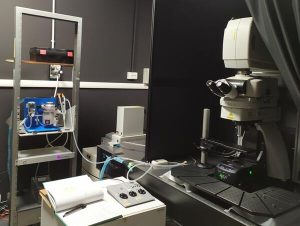
Nikon A1RMP High-Speed Multi-Photon Microscope
- Motorized stage for in vivo, ex vivo, in vitro imaging
- Galvano + Resonant scanners for high-speed acquisition
- Femtosecond pulsed Ti:Sapphire IR-laser, tunable 700–1080 nm
- Objectives:CFI60 Planfluor 10× NA 0.3 (16 mm); CFI75 LWD 16×W NIR NA 0.80 (3 mm); CFI75 LWD Apo 25×W NA 1.0 (2 mm); CFI60 Apo 40×W NIR NA 0.80 (3.5 mm)
- Detector: 4-channel GaAsP NDD high-sensitivity

Light Sheet Microscopy
Milteny iBiotec Ultra Microscope II
- Fluorescence light sheet microscope for large-scale 3D imaging
- Sample size: up to ~1 cm (organoids, mouse embryos, brain, organs, tumors, tissue sections)
- Objectives: Zoom 2× NA 0.5; Super Plan 1.1× NA 0.1, 4× NA 0.35, 12× NA 0.53
- Magnification: 1.26×–12.6× (Zoom), 0.66×–30× (Super Plan)
- Light sources: 5-line laser (405, 488, 561, 639, 785 nm) or supercontinuum (460–800 nm)
- Detector: sCMOS camera (5.5 MP, 60% QE or 4.2 MP, 82% QE, up to 100 fps)
- Applications: whole-organ fluorescence imaging, single-cell detection, 3D network mapping, time-lapse LSFM

Widefield Microscopy
ZEISS Apotome 3 / Axio Imager Z2
- Illuminator: Colibri 7 FR-R[G/Y]BV-UV
- Cameras: Axiocam 705 mono R2, Axiocam 305 color R2
- Objectives: 5×, 10×, 20×, 40×, 63×
- Filters: DAPI, GFP, Cy3, Cy5
- Workstation: ZEISS 60A R2 (HP Z6)

Slide Scanning
Zeiss Axioscan Z.1
- Illuminator: Colibri 7, R[G/Y]CBV-UV
- Cameras: Hitachi HV-F203, Orca Flash 4.0 V3
- Objectives: 5×, 10×, 20×, 40×, 63×
- Filters: 38 HE eGFP, 43 HE Cy3, 56/90/91/92 HE LED, 108 HE LED
- Slide capacity: 25×4, 5×2, 1×1
- Workstations: ZEISS 55A R2 & 60A R2, Intel Xeon, NVIDIA Quadro graphics

Neurolucida Systems
NL Workstation 1
- Nikon Eclipse E600, motorized stage
- Camera: Microfire 2 MP Color (1600×1200)
- Lenses: 2×, 4×, 10×, 20×, 40×, 100×
- Filters: DAPI, Green (Cy2/Alexa488), Red (Cy3)
- Software: Neurolucida, Neurolucida Explorer, Stereoinvestigator
NL Workstation 2
- Nikon Eclipse 80i, motorized stage
- Cameras: 3/4″ CCD 1.92 MP, Microfire 2 MP
- Lenses: 4×, 10×, 20×, 40×, 60×, 100×
- Filters: DAPI, Green, Red, Dark Red
- Software: Neurolucida, Neurolucida Explorer

Specialized microscopes
Sartorius IncuCyte S3
- Real-time, automated live-cell measurements inside the incubator (non-perturbing environment)
- Long-term imaging: hours to days
- Objectives: 4×, 10×, 20× (automated turret)
- Imaging modes: HD phase contrast, red & green fluorescence
- Assay formats: 96- and 384-well plates (up to 6 simultaneously)

Microscopy price list